5 Best Stretches and Exercises for Thoracic (Mid-Back) Pain Relief
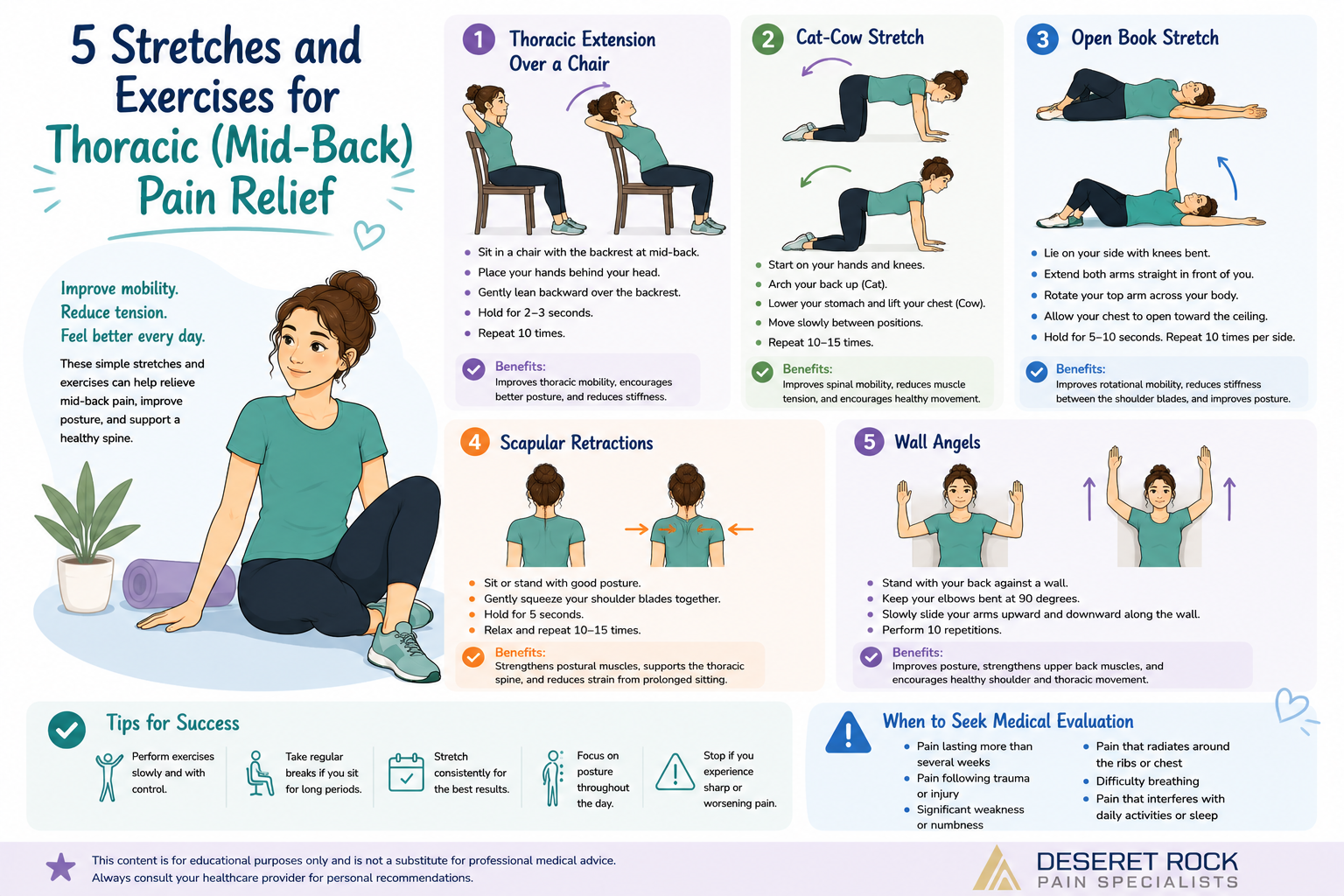
5 Stretches and Exercises for Thoracic (Mid-Back) Pain Relief
Thoracic pain, often felt between the shoulder blades or across the mid-back, is a common source of discomfort. Long hours at a desk, poor posture, repetitive activities, muscle strain, and spinal conditions can all contribute to pain in this region.
The thoracic spine is designed for stability, but when the muscles and joints become stiff or irritated, even simple movements can become uncomfortable. Fortunately, gentle stretching and strengthening exercises can often help improve mobility, reduce tension, and support a healthier spine.
1. Thoracic Extension Over a Chair
This exercise helps reverse the effects of prolonged sitting and slouching.
How to Perform:
- Sit in a sturdy chair with a backrest that reaches your mid-back.
- Place your hands behind your head.
- Gently lean backward over the backrest.
- Hold for 2–3 seconds.
- Repeat 10 times.
Benefits:
- Improves thoracic mobility
- Encourages better posture
- Reduces stiffness
2. Cat-Cow Stretch
This gentle movement improves flexibility throughout the spine.
How to Perform:
- Start on your hands and knees.
- Slowly arch your back upward (Cat).
- Then lower your stomach and lift your chest (Cow).
- Move slowly between positions.
- Repeat 10–15 times.
Benefits:
- Improves spinal mobility
- Reduces muscle tension
- Encourages healthy movement
3. Open Book Stretch
This stretch targets thoracic rotation.
How to Perform:
- Lie on your side with knees bent.
- Extend both arms straight in front of you.
- Slowly rotate your top arm across your body toward the opposite side.
- Allow your chest to open toward the ceiling.
- Hold for 5–10 seconds.
- Repeat 10 times per side.
Benefits:
- Improves rotational mobility
- Reduces stiffness between the shoulder blades
- Helps improve posture
4. Scapular Retractions
Strong upper back muscles support the thoracic spine.
How to Perform:
- Sit or stand with good posture.
- Gently squeeze your shoulder blades together.
- Hold for 5 seconds.
- Relax and repeat 10–15 times.
Benefits:
- Strengthens postural muscles
- Supports the thoracic spine
- Reduces strain from prolonged sitting
5. Wall Angels
This exercise promotes thoracic mobility and shoulder stability.
How to Perform:
- Stand with your back against a wall.
- Keep your elbows bent at 90 degrees.
- Slowly slide your arms upward and downward along the wall.
- Perform 10 repetitions.
Benefits:
- Improves posture
- Strengthens upper back muscles
- Encourages healthy shoulder and thoracic movement
Tips for Success
- Perform exercises slowly and with control.
- Focus on posture throughout the day.
- Take regular breaks if you sit for long periods.
- Stretch consistently for the best results.
- Stop if you experience sharp or worsening pain.
When to Seek Medical Evaluation
Thoracic pain should be evaluated if you experience:
- Pain lasting more than several weeks
- Pain following trauma or injury
- Significant weakness or numbness
- Pain that radiates around the ribs or chest
- Difficulty breathing
- Pain that interferes with daily activities or sleep
We Can Help
At Deseret Rock Pain Specialists, we evaluate and treat many causes of thoracic pain, including facet joint pain, disc-related conditions, nerve irritation, muscular pain, compression fractures, and chronic spine conditions.
Our goal is to help you identify the cause of your pain and develop a treatment plan that helps you move better and feel better.
If thoracic pain is limiting your quality of life, contact Deseret Rock Pain Specialists to learn more about your treatment options.
Have Questions About Pain Management?
Our team of specialists is here to help. Schedule a consultation to discuss your specific needs.
This content is for informational purposes only and is not medical advice. Always seek care from a qualified clinician for diagnosis and treatment. If you are experiencing a medical emergency, call 911 immediately.