Facetogenic Back and Neck Pain: When the Small Joints of the Spine Cause Big Pain
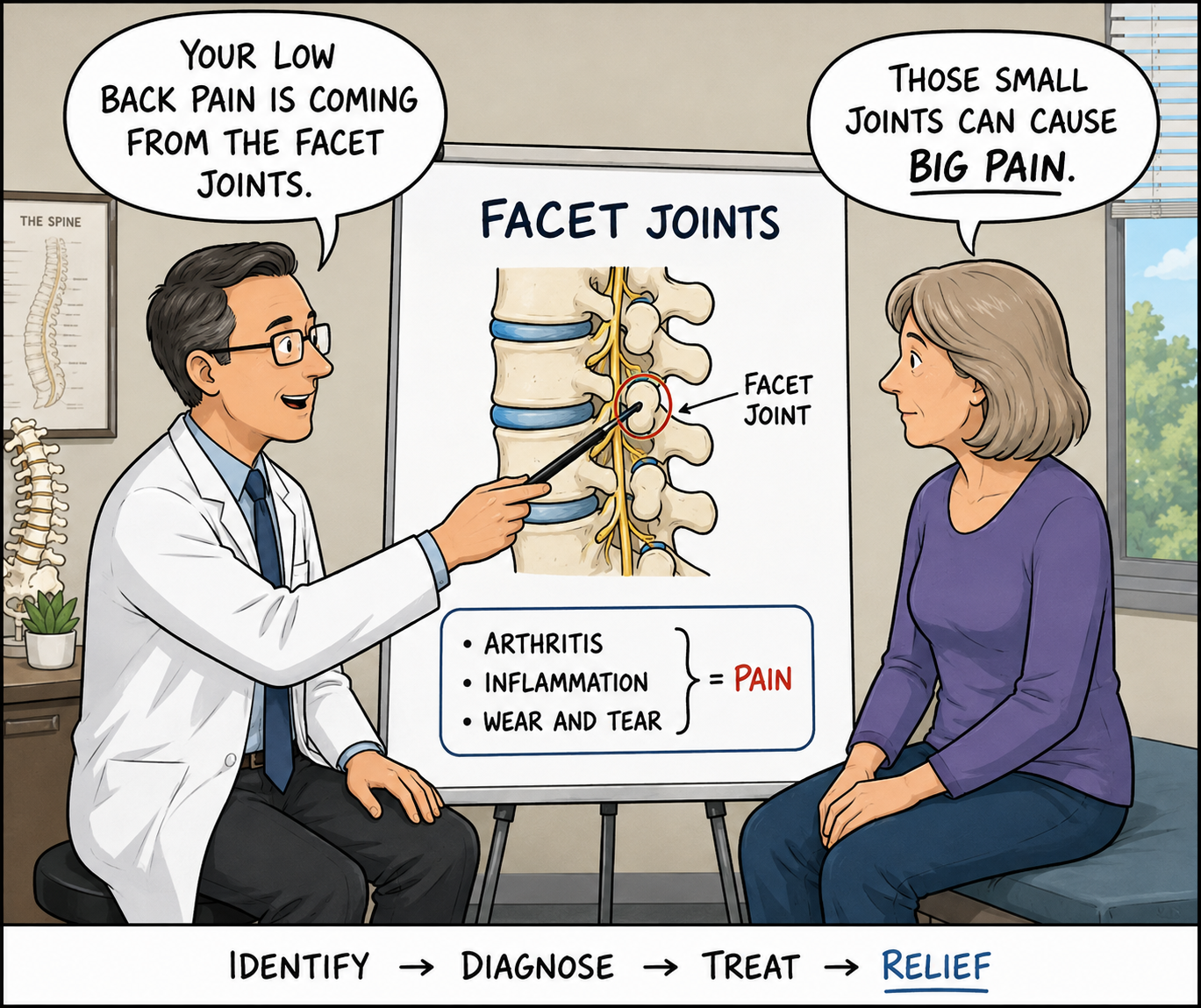
Facetogenic Pain: When the Small Joints of the Spine Cause Big Pain
Neck and low back pain are extremely common, but the source of the pain isn't always a disc or a pinched nerve. In some people, pain comes from the facet joints—small joints located along the back of the spine. When these joints become painful, the condition is often called facetogenic pain or facet joint pain.
Understanding whether the facet joints are contributing to your pain is important because facet-mediated pain can often be treated without surgery.
What Are Facet Joints?
Facet joints are small paired joints located at each level of the spine. Like the knee, hip, or other joints in the body, they contain cartilage and allow movement between bones.
The facet joints help your spine:
- Bend and straighten
- Twist and rotate
- Maintain stability
- Control excessive movement
Over time, these joints can develop arthritis, inflammation, or degenerative changes. Injury or repetitive stress can also make them painful.
What Does Facet Joint Pain Feel Like?
Facetogenic pain is usually axial, meaning the pain is centered primarily in the neck or low back rather than traveling down an arm or leg.
Lumbar Facet Pain
Facet pain in the lower back may cause:
- Aching pain across one or both sides of the low back
- Pain extending into the buttocks, hips, or upper thighs
- Increased pain when standing for prolonged periods
- Pain when leaning backward or twisting
- Stiffness, particularly after inactivity
Pain caused by the lumbar facet joints generally does not produce the classic shooting pain down the leg associated with “sciatica”.
Cervical Facet Pain
Facet pain in the neck may cause:
- Aching or stiffness in the neck
- Pain on one or both sides of the neck
- Pain extending into the shoulders or upper back
- Pain extending toward the back of the head
- Increased pain when looking upward or turning the head
Depending on which cervical facet joints are involved, facet-mediated pain can sometimes contribute to certain types of headaches.
What Causes Facetogenic Pain?
Facet joint pain may develop from:
- Osteoarthritis and normal wear and tear
- Degenerative changes in the spine
- Previous neck or back injuries
- Whiplash injuries
- Repetitive stress
- Changes in spinal mechanics
- Degenerative disc disease that places additional stress on the facet joints
An MRI or X-ray may show facet arthropathy, which means degenerative or arthritic changes are present in the facet joints.
However, imaging alone cannot always determine whether a particular facet joint is actually causing pain. Many people have arthritis on imaging without experiencing significant symptoms.
How Do We Determine if the Facet Joints Are Causing the Pain?
The diagnosis begins with a medical history, physical examination, and review of appropriate imaging.
If facetogenic pain is suspected, a procedure called a medial branch block can help determine whether the facet joints are actually responsible for the pain.
The facet joints receive sensation from small nerves called the medial branch nerves. During a medial branch block, a small amount of local anesthetic is placed around these nerves using image guidance.
The goal is simple: temporarily numb the nerves carrying pain signals from the suspected facet joints and see how much the patient's usual pain improves.
Significant temporary relief provides evidence that the targeted facet joints are likely contributing to the pain. Because diagnostic blocks can occasionally produce false-positive results, many treatment protocols and insurers require two successful diagnostic medial branch blocks before proceeding with radiofrequency ablation. Medicare coverage policies, for example, generally require two diagnostic blocks producing at least 80% relief before an initial facet radiofrequency ablation.
What Is Radiofrequency Ablation?
If medial branch blocks confirm that the facet joints are a significant source of pain, radiofrequency ablation (RFA) may provide longer-lasting relief.
Rather than injecting medication into the joint, RFA treats the small medial branch nerves that transmit pain signals from the facet joints.
During the procedure, specialized needles are positioned next to the appropriate nerves using image guidance. Radiofrequency energy is then used to create a small, controlled lesion in the nerve, interrupting its ability to transmit pain signals.
The procedure does not remove the facet joint or fuse the spine.
How Long Does Radiofrequency Ablation Last?
The medial branch nerves can eventually regenerate, so radiofrequency ablation is not necessarily permanent. However, successful RFA can provide substantially longer relief than the temporary anesthetic used during diagnostic medial branch blocks.
Clinical guidelines and Medicare coverage reviews support medial branch radiofrequency ablation as a treatment option for appropriately selected patients with facet-mediated neck or low back pain.
If the nerves regenerate and the same pain eventually returns, radiofrequency ablation can be repeated when the initial procedure provided meaningful and sustained relief.
Is Facetogenic Pain the Same as a Pinched Nerve?
No. This distinction is important.
A pinched or irritated spinal nerve may cause radicular symptoms such as shooting pain, numbness, tingling, or weakness extending into an arm or leg.
Facetogenic pain is generally more localized to the neck or back, although it can refer pain into nearby areas such as the shoulders, buttocks, hips, or thighs.
Some patients can have more than one source of pain at the same time, so identifying which structures are actually contributing to the symptoms is an important part of developing an effective treatment plan.
When Should You Be Evaluated?
If neck or low back pain continues despite treatments such as activity modification, physical therapy, anti-inflammatory medications, or other conservative measures, further evaluation may help identify the source of the pain.
Facetogenic pain is only one of several possible causes of chronic neck and back pain. Determining whether the pain is coming from the facet joints, discs, nerves, sacroiliac joints, muscles, or another structure allows treatment to be directed toward the actual pain generator.
At Deseret Rock Pain Specialists, we evaluate the underlying cause of persistent neck and back pain and offer both non-surgical and minimally invasive treatment options. For patients with suspected facetogenic pain, diagnostic medial branch blocks and radiofrequency ablation may provide an effective pathway toward longer-lasting pain relief.
Have Questions About Pain Management?
Our team of specialists is here to help. Schedule a consultation to discuss your specific needs.
This content is for informational purposes only and is not medical advice. Always seek care from a qualified clinician for diagnosis and treatment. If you are experiencing a medical emergency, call 911 immediately.